Friday, 7 December 2012

The Future of Cameras

Photo taken by my wife at the
Colosseum in Rome in 2011
 
Me and my Camera
For over 20 years I have been a serious photographer. The question I always get asked from my friends when they hear I am travelling somewhere is “How many cameras are you bringing?”. Normally I travel with a minimum of two cameras plus 3-5 different lenses, flash and tripod. I am a serious "gear head" when it comes to photography, mostly from the standpoint of what new equipment can I use to take better pictures. I am always striving to get the best quality photographs with the equipment I have. When digital cameras started entering the amateur market in the late 1990's I wasn't impressed with the image quality when compared to my film cameras. Today is a very different time and I am really excited where current photographic technology is going and how much easier it is to take really good high quality pictures. Over the past three years I have seen impressive improvements in camera technology in cell phones and if this trend continues, your smart phone will soon be taking pictures just as good as a dedicated camera. This prompted me to think of what people’s expectations are when it comes to cameras and photography.

Speaking for myself, I am an advanced amateur or semi-professional photographer and I will never give up my large and complex Digital Single Lens Reflex camera (DSLR) with multiple lenses and external flashes. That made me think of what the average person expects from new cameras. The divergence in photography where smart phone cameras are taking many more photos than they used to made me think of the differences between a smart phone and a dedicated camera. I love using my IPhone 4GS and the 8mp camera is really great for taking snapshots. But what I really love about it is the ability to transfer images right away through WiFi or 3G. The majority of cameras today, although being very sophisticated, lack connectivity to the Internet. With almost everything electronic these days having some means of connecting to a WiFi hot spot, cameras are actually lagging behind. If the last three years have taught me anything about what people like in their electronic gadgets it is the accessibility to the Internet and specifically to their favourite sites. Why can’t cameras have that connectivity, and do people expect future cameras to be connected?

In order to test my curiosity I developed a short survey and administered it using the NPolls App. This poll was conducted on June 22nd, 2012 and sampled 500 people. This survey is not representative of any particular group, unless you count the people who have the NPolls App and want to participate in regular polls. The questions for this survey related to what features people expect will be part of new cameras.

Below are some of the results from the poll survey, if anyone would like to review all questions and results please feel free to download the following file (NPolls results). The breakdown of respondents are: 55% male and 45% female, which is the reverse of the actual demographic breakdown in the population. Regarding age, 81.8% of all respondents are between 15 and 39 years of age (Table 1). I used SPSS version 20 to analyse and sort through the results.

Age
Number
Percentage
< 15
20
4
15-24
184
36.8
25-39
225
45
40-54
65
13
55-65
5
1
65+
1
0.2
Total
500
100%
Table 1: Age breakdown of survey respondents

Survey Results 
Some of the highlights and interesting results from the survey are below. The survey asked people to consider a series of statements on a 5 point scale from Strongly Disagree (1) to Strongly Agree (5). The results were grouped by the first 3 points on the scale (1-3) as Disagree and the last two points (4-5) as Agree. The first question I asked was what type of camera do you regularly use to take pictures with? The answers for this first question are not mutually exclusive and the results are not very surprising with the overwhelming number of people using their cell phone cameras most often (Table 2). 

Type of Camera
Number
Cell Phone
421
Point & Shoot
98
Bridge
48
Single Lens Reflex (SLR)
49
Film
10

Table 2: What camera do you regularly use to take pictures with?

The second question prompted people to consider "Cell phone cameras will replace dedicated cameras for everyday use." Out of 500 people 290 disagreed with this statement that cell phones will replace dedicated cameras (Table 3). I am a little surprised at this number, I would have thought a majority of people would have agreed. There is already talk among the photography blogs and from other professionals that cell phone cameras are already replacing point and shoot cameras. There is already speculation that as a category, point and shoot cameras will disappear in the next few years. 


Disagree
Agree
Total
Female
135
90
225
Male
155
120
275
Total
290
210
500

Table 3: Cell phone cameras will replace dedicated cameras for everyday use.


One thing I find interesting about this result from the statement "Future cameras will have touch screens", even though 60% agree with this statement, all of the people who filled out this survey were using touch screen smart phones or tablets (Table 4). This is one more result I would have expected to be a much higher number. 


Disagree
Agree
Total
Female
86
139
225
Male
116
159
275
Total
202
298
500

Table 4: Future cameras will have touch screens.


WiFi made more ubiquitous if
included in your camera
The next statement asked "Future cameras will have WiFi capabilities". This result is very interesting, with 75% agreeing with my statement (Table 5). This should be an indication of one way future cameras will really change how they work and what people will expect from them. At the time of writing this blog there were only a handful of cameras on the market with WiFi capability, and I expect by this same time next year (Dec 2013) the majority of cameras will have WiFi built in.


Disagree
Agree
Total
Female
58
167
225
Male
67
208
275
Total
125
375
500

Table 5: Future camera will have WiFi capability.


A SIM card in every camera


The number of people agreeing with the statement "Future cameras will have SIM card capabilities" is about as high as I expected at 57% (Table 6). I really like this idea of cameras having a SIM card. One great benefit of this is for photojournalists where there is no WiFi. Instead of your camera having a phone number (like your cell phone) it would have an address on the Internet from where you could be connected. Recently the world was captivated by the coverage from the streets of Cairo and other Middle Eastern cities during the Arab Spring. Just imagine if all that footage was in 1080 HD video rather than the small cell phone cameras and was streamed live.


Disagree
Agree
Total
Female
79
146
225
Male
135
140
275
Total
214
286
500

Table 6: Future camera will have SIM card capability.

Out of 500 people 392 (78%) agree with this statement "Future cameras will upload directly to the Internet" (Table 7). This statement is related to the WiFi and the SIM card question but it’s more to do with the changing expectation of how people will get pictures off their cameras and be posted directly to the Internet without the need for a computer. Just imagine a camera with a Facebook, Instagram or Youtube button where files can go directly on line. Also for those professionals working in the field who do not need to post pictures quickly but want to make sure they have another backup before they leave the field, this would be a useful feature. You could be able to automatically upload directly to the Cloud, to your own personal FTP (File Transfer Protocol) site or your own home server.


Disagree
Agree
Total
Female
42
183
225
Male
66
209
275
Total
108
392
500
Table 7: Future camera will upload directly to the in Internet.


Coming to a camera near you
The number of people agreeing with the statement "Future cameras will be able to use photography related Apps" was 354 people (71%) (Table 8). This result should not be a surprise since Apps are becoming a very important part of smart phones and tablets, and they should be part of cameras as well. At the time of writing Nikon had announced they were going to allow Apps to be downloaded to their Nikon Coolpix line of cameras. I’m delighted to see Nikon embracing Apps. This actually surprised me since none of the large camera companies are normally open to allow third party companies access to their camera software. Just think of the additional profits some companies and individuals can make supplying Apps for cameras.


Disagree
Agree
Total
Female
59
166
225
Male
87
188
275
Total
146
354
500
Table 8: Future cameras will be able to use photography related Apps.

The next question prompted people to consider the following statement, "Future cameras will allow more in camera editing" and out of 500 people, 354 (71%) agreed with this statement (Table 9). This result should not be a surprise since many cameras are already offering limited in-camera editing. Just imaging a mini version of Photoshop on your camera with greater editing tools. This would also require more processing power and more memory in your camera for needing to work on and save files. One thing to consider is what will be the role of computers to edit and modify pictures, if more editing will be done in the camera?


Disagree
Agree
Total
Female
42
183
225
Male
64
211
275
Total
106
394
500
Table 9: Future cameras will allow more in camera editing.

Out of 500 people 348 (70%) agreed with this statement "Future cameras will allow tethering to a tablet computer" (Table 10). Tethering does not only mean an actual physical cable connected to the camera but can also mean through WiFi. I personally love shooting tethered to a computer when I am doing studio work. It’s always better to see the photograph on a computer monitor right away than on the back of the camera. Since tablet computers are becoming very popular, I would expect to be able to connect my camera to a tablet computer for easier shooting and use additional portable computing power.


Disagree
Agree
Total
Female
68
157
225
Male
84
191
275
Total
152
348
500
Table 10: Future cameras will allow tethering to a tablet computer.

I still use film occasionally and I had to ask this question "Do you expect film will still be available in the future?" which has nothing to do with the future of cameras but indulged my own curiosity. Although I was surprised that 38% of people agree with this question (Table 11). When people find out I still shoot film I always get asked "You can still buy film?" which is why it surprises me that 189 people still think film will be available in the future.


Disagree
Agree
Total
Female
148
77
225
Male
163
112
275
Total
311
189
500
Table 11: Do you expect film to still be available in the future? 

The future of cameras…

The next camera you buy could
have all these features
My overall impression from these results was that  predominately the respondents agreed with my statements, which suggests I didn’t ask anything too surprising. It wasn’t my intention ask anything out of the ordinary, but merely to see if technology and features that already exist in smart phones would be well received in dedicated cameras. Another aspect of this survey is also to see where the future profits for the camera companies may come from. According to many photography sites, the mega pixel war has ended and since most cameras take very good high quality images, how will camera companies entice people to continue to upgrade. If mega pixels are no longer the driving motivator behind upgrading cameras, then the connectivity features, along with Apps, and touch screens could be a big motivator for buying a new camera. Since cell phones are acting more like cameras then in order for people to continue buying cameras in large quantities, cameras should start acting like cell phones. Finally Facebook, Flikr and Instagram have demonstrated how important photographs and video are to people’s everyday lives. If camera companies add some (or all) of the features I have been talking about into new cameras there could be a significant increase in the volume of images flooding onto the Internet. 


Just to reiterate the point of this blog is not to talk specifically about technology but about how we use technology and what we expect from our technology. The results from the survey suggest to me that people want and expect all of their technology to be easy to interact with (eg. touch screens) and be versatile to accommodate their busy lives (eg. use of Apps) and constant connectivity to the Internet where much of people’s lives are already and will be more so in the years to come.

Thursday, 16 August 2012

Hunting and Gathering at the supermarket: Made more enjoyable and meaningful

The Shopping Question
Why do women enjoy shopping more than men do? We know men love to buy things, and spend money, but why is shopping considered something women enjoy doing more than men? I have a theory as to why this is.

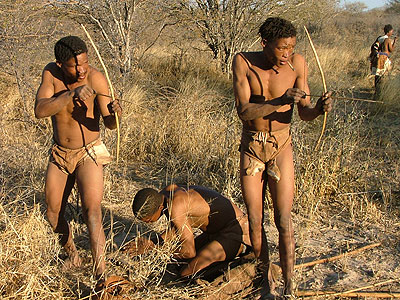
Modern example of hunting by !Kung San
from southern Africa
For hundreds of thousands of years we have been hunters and gathers and between men and women there existed a specific division of labour. This division of labour was not based on some sexist notion but out of a practical one, based on the differences between men and women. Men did the majority of hunting while women did the majority of gathering. Small groups of men would spend hours and even days out on hunting parties, and women, along with their children, would spend their day gathering all of the edible plants, roots, tubers and other fruits around the base camp. Women also regularly hunted and captured small game, so they were not excluded from the savage act that only men were expected to perform.

The scenario during a hunt centered around a small group of men working together and quietly stalking an animal. The men would have developed many signs and “looks” to communicate covertly in order not to startle their prey. On their hunting trip men would bring small portions food to sustain them, or gather whatever foods they could find.  But on the whole they ate only when they were not stalking their prey.

Modern example of Yanomami women gathering 
food from the Amazon region in South America 
The situation with the women on the other hand was much different while gathering food, which was the main source of food for the average small and mobile communities. Small groups of women with their children would go out from the camp and gather the various foods. This was a more communal atmosphere where the women would be free to talk amongst themselves, without the fear of startling their prey. Over the course of the gathering they would taste and sample the produce as they moved in order to rate its quality and ripeness. Not all foods could be sampled and some foods needed preparation though peeling, crushing or cooking to become edible. Young children at various ages would accompany and participate in the collecting and be learning what was ready to pick and what was not.

This behaviour is mirrored in the activities of men and women today in the 21st century. Women by their nature snack while cooking and taste (sample) foods at the grocery story, usually accompanied by their children. The usual scene of women together when cooking is constant chatting. The men on the other hand don’t exactly act as their hunting ancestors did, but there are times when men are together and say very little to each other, but can still have a deep acknowledgement from just a “look”.

Gathering in the modern age
I believe that the act of gathering is closer to the shopping experience where you browse or search through the shelves picking the right item that satisfies your immediate need. This could be why women enjoy shopping more than men do. Women have always done the majority of gathering relative to men and also for women shopping is a much more social activity with other women, unlike with men where men rarely shop with other men. This is not an absolute statement but it’s merely meant to point out the traditional ways in which men and women used to interact with the natural world. We don’t think of a shopping mall or supermarket as the natural world but these are the places where we get our resources, foods and supplies.

What does this mean for Marketing Research?

The shopping experience
The mother/child dynamic
with gathering has not changed
in thousands of years
As marketing researchers, the main point to come away with to understand that since men and women instinctively treat shopping differently retailers should not expect the same marketing techniques to work on both of them. Since women do the majority of shopping for a household, they are targeted more often and more intensively than men. Even in a supermarket, different strategies should be employed for men and women.

The solitary hunter
For example the power of free samples given in supermarkets (and at the LCBO) clearly work to sell more products and introduce customers to new products. I would suggest placing these tasting tables at locations where those products are regularly kept and not just at random locations around the store. Changing the location of products in stores does expose people to new products but also confuses them. I always considered this practise of moving products around a store just to increase sales and expose people to new products a cheap parlour trick (The LCBO regularly moves around groups of products within their stores). One thing that people don’t like is change. Where everything in their lives is in constant flux, people like to know they can rely on their local supermarket for the brands they enjoy using. Instead of changing products around a store, why not set-up a tasting booth of products you want to move and let people’s instinctive gathering tendencies re-surface.
"Where did I find those beans last time?"

People are also very vocal and if they recommend a product to family and friends the first question they are asked is “where can I find it?” This goes beyond just identifying a specific store, just like during our hunter-gatherer days, people want to know exactly over which hill and behind which bush to find those great ripe berries. People will rarely search all over a store for something if it's not where they expect to find it.

Cavemen went extinct long before the
supermarket arrived


In conclusion, are modern supermarkets maximizing the shopping experience? Or is there something more they can do?

Here is my suggestion. One important aspect of the shopping experience that is different from when our ancestors gathered for food is the lack of information. Groups of women would go gathering together and share information on all the different foods available. With the vast array of edible products in supermarkets, one idea is to employ roving "Product Specialists" throughout the store. These people can suggest recipes or answer questions regarding different foods to make recommendations. Suggestions such as different spices, side dishes and condiment pairings and get people to go to different parts of the store they would not normally go to. Since people visit their local supermarkets regularly these Product Specialists can also act as the front line interaction with the customer and build relationships over the long term.

The missing piece of the
gathering paradigm?

Due to the fact that everyone needs to eat, our supermarkets should not merely a be a commercial experience but should be places where people can explore culinary delights from around the world. If they enjoy their shopping experience, this is one way to encourage people to return and tell their friends and family, which for thousands of years has always been the best form of advertising.

Thursday, 21 June 2012

Ancient Fire and the Internet

My latest blog called "Ancient Fire and the Internet" appears on the blog called Market Research Technology.  Enjoy!

Monday, 26 March 2012

Are tablet computers the future of computing?


Tablet computer
Do you have a tablet computer? If you answered yes, why did you buy one? Are you the type of person who loves the latest hot gadget, or did you buy one for its portability? I bought one in December 2011. I already have a smartphone, a desktop, a laptop and a netbook computer. I am not the type of person who always needs the latest gadget. So why did I buy a tablet computer? I am also a photographer and bought the tablet primarily to show my portfolio to clients and use as a marketing tool. The fact that the tablet doubles as a handy e-reader was a bonus. The reason I recently bought it was due to the lower prices now available. My experience with the tablet in the past few months has been very positive. I can honestly say I love it! I can’t do everything with it that I normally use a computer for. I still use my smart phone for emails, I use my desktop for all photographic editing and file management and I still use my netbook when I need to do portable word processing or spreadsheet work. So why did I buy a tablet computer? As I already mentioned the main reason was because of the reduced price.

My survey on the use of tablet computers
Before I bought my tablet computer I was already thinking about the way people use computers, smart phones, and tablets and I was curious to see if there was a possible trend for portability and convenience over the traditional stationary computer use. In order to test my curiosity I developed a short survey and administered it using the NPolls App. This poll was conducted on December 15th, 2011 and sampled 100 people. This survey is not representative of any particular group, unless you count the people who have the NPolls App and want to participate in regular polls. The premise for this poll was that smart phones and tablet computers are slowly replacing the traditional roles of desktop and laptop computers.

Below are some of the results from the poll survey, if anyone would like to review all questions and results please feel free to download the following file (NPolls results). The breakdown of respondents are: 53% female and 47% male, which is the actual demographic breakdown in the population. Regarding age, 75% of all respondents are between 15 and 39 years of age.

No.
Age Range
9
<15
35
15-24
40
25-39
14
40-54
1
55-65
1
65+
Table 1: Age breakdown of survey respondents

The breakdown in gender probably says more of who took the time to answer the poll, rather than the questions asked. The largest group for both genders is between 25-39 years old (representing 40% of the entire sample). Anytime you breakdown data from a small sample you are limited to what conclusions that can be reached. Having said that it’s still interesting to identify any differences with a small sample and see if they are consistent if a similar study is conducted in the future.
What do you use your
smart phone for?

Female
Age Range
Male
7
<15
2
19
15-24
16
20
25-39
20
7
40-54
7
0
55-65
1
0
65+
1
53

47
Table 2: Breakdown by gender and age groups of survey respondents

I asked questions relating to what devices people use such as desktop, laptop/tablet or phone/smartphone for the following computer work such as: Email, using the internet, edit/create images, word processing and spreadsheet work. Here are the results:


Email
Using the net
Edit/create
image
Word
processing
Spreadsheet
work
Desktop
13
24
34
38
43
Laptop/tablet
44
62
56
68
67
Phone/smart phone
63
36
24
13
4
Table 3: Number of respondents regarding each question asked in the survey. Figures in bold are highest value in question.


To briefly summarize the results, overall people used their laptop/tablet computers for the majority of tasks. While phone/smart phone use was first for emails, and second for using the internet. The results above appear to be what I was expecting to find.

Some computing work still needs the use of a laptop or desktop computer that have larger hard drives (HDD), extra RAM, added comfort with sitting at a desk and the extra processing power (faster CPU). As a photographer who needs to use powerful editing software and access to all my photos and backups I only use my desktop when doing any editing or adjusting. Even though I have smart phone, netbook, and tablet computer I always use my desktop for serious photographic editing. I realize I may be the exception and I think this very simple survey speaks to that distinction. Where the majority of people will be using smaller and more portable devices for the majority of their 'computer' work, this is where the mainstream is going, small portable devices where people can fulfill the majority of their computing needs.


All the right technology at the right time 
The incredible rise in popularity of tablet computers started me thinking about all the technology that has finally come together to make tablet devices affordable and practical. Here is a simplified list of all the technology that has allowed the rapid expansion of tablet and other portable devices:
The ubiquitous nature of Wi-Fi has
permitted the proliferation
of small computing devices
  • Better longer lasting batteries
  • Ease of use through simple graphic user interface (GUI)
  • Faster processors (CPU)
  • Use of Solid State drives (SSD) replacing traditional Hard drives (HHD) (permitting much faster operation in a smaller size)
  • Wi-Fi hot spots in many more places (also increased speed of Wi-Fi connections)
  • 3G and 4G SIM card capability 
  • Cloud computing access
  • Use of a touch screen, removing the need for a mouse, stylus or keyboard thus making the device mush lighter and faster to use
  • Reduced price of tablet computers 
  • The use of Apps


Apps – Food for the tablet computer (Or the rise of the Uni-task program)
An App (or software application) is not only a miniature program but think of it more as a segment of a much larger software package that we are used to. With traditional computers people had to spend hundreds of dollars on an entire software package such as Adobe Creative Suite or Microsoft Office and install most of the programs. But how many people actually used all the features in an entire software package?


Are large multi-program software
packages becoming obsolete?
 
Tablet computers look and act less like large smart phones but more like small computers and the benefit of Apps in low price and low memory usage have the ability to change the computing experience into a much more user friendly and personally tailored to the individual user. The key word here is tailored. The arrival of the personal computer heralded the age of mass computing in the 1980’s but the software and portability aspect of computers has just recently arrived in the past few years. Portability has always been a problem until the past 5-10 years when battery longevity has come of age (and there are better batteries yet to come). Now with the arrival of Apps, the individual can personalize their computing device and only pay and install those programs that he/she wants to use.


Open source Android programming code has changed
the rules with the way software is made, sold and used
The main message to marketers and companies is that the masses want to use computers that are convenient, simple to use and affordable. This is not a profound revelation, but the point I'm trying to make is that all aspects of computing and portability need to be considered for the complete experience, including software. No one could have predicted the meteoric rise in the use of Apps, nor the sales potential. The open source Android system which allows anyone to create software for portable computing devices has the potential to change the way corporations make and sell software. Not to mention the way people will expect to use programs from here on.

In the 1990's cell phones allowed people to be truly mobile for the first time and when email was added to phones this definitely freed people from the old 'computer terminal'. This trend in portability continued with laptops but only recently with the spread of Wi-Fi hotspots (and 3G and 4G capable tablets) could people be mobile and still stay connected. The trend observed by the survey data above suggests that people want more portability and total connectivity with the internet. Not only are tablet computers very hot and popular now, the reduced prices and increased computing power combined with large number of Apps, might be the keys to their increase in popularity and could be replacing laptops soon as the dominant computing device.  

The $50 tablet computer - A game changer
The Akaash Tablet by Data Wind - made in India
Earlier last year the Indian government issued a tender from all manufacturers of tablet computers to build a unit that the average Indian could buy. I don’t know the reason why the Indian government chose a tablet device over a laptop other than the simplicity of use of a tablet. The potential for one billion extra people on the internet contributing, searching, communicating and socializing can only be a positive thing. The company that won the contract is a UK based company with roots in Canada, called Data Wine, it is managed and operated by two brothers of Indian descent. They were able to make a device for $50 and the Indian government will subsidize each unit costing only $35. The initial goal is to put a unit in the hands of every student who can not afford a computer.  For more details click here to read the story in the Globe and Mail.

Considering for the moment the potential of this table on India alone. Imagine one billion more people accessing the internet, communicating and contributing, you get a billion more ideas, and more creativity. As market researchers we get a billion more opinions to track. Add to that the Android open source programing code think of the potential of this on 1 billion more people writing programs for Android systems.

Will Asia be where the real computer revolution will occur?


To leave you with one final thought, just imagine what will happen when China starts developing and producing their own tablet computer less than $50, then a further billion people can contribute to the creativity and energy for all humanity. Then the real computer revolution can start.

Monday, 5 December 2011

Product and corporate branding through images


STOP
The ubiquitous stop sign.
The real stop sign?
The octagon shaped stop sign is one of the most widely recognized signs in the world. But if you’ve never seen a stop sign before and don’t understand the language written on it, there is nothing about the sign that tells you to stop. Stopping is a very fundamental sign for all people, so why isn't the universal symbol for stopping something that we can relate to, such an opened hand in your way? The communication of ideas, messages and complex concepts has always been a challenge for people, especially when dealing with different languages and different ways of looking at the world. There are some universal symbols and images that convey a lot of information which  connect with people quicker and in a more meaningful way. Therefore in this blog I will briefly cover how we instinctively use signs and pictures to communicate information and how this could help companies better brand themselves.

Back to Basics
People are very visual and since the earliest recorded information (art) on cave walls, on bits of wood and bone, people have tried to convey as much information as possible using the limited media that was available. Some of the earliest writing in the world took the form of pictograms where a drawing of an object was used to represent an idea to convey meaning. One of the earliest forms of writing is from the Sumerian civilization (Early Bronze Age era circa. 3000 Before Common Era (BCE)) located between the Tigris and Euphrates rivers in modern day Iraq.

Early Sumerian writing
This form of what we would classify as writing, called Sumerian cuneiform, was made up of a series of symbols that represented items of everyday commerce, developed for book keeping and accounting. Symbols such as grain, cattle, goats, hides and slaves then later on the location of these important commodities were also included into this system, such as rivers, mountains, sea etc… This wasn’t the only vocabulary in the ancient Sumerian language but these were the most important signs for everyday commerce that needed to be recorded and tracked.

Sumerian writing used over 3000 years
For example, the symbol for god or heaven was a star, the symbol for man was the bust of a man, the symbol for food was a bowl and the symbol to eat was the symbol for man and a bowl together. The ancient Sumerian language is a great example of how simple drawings developed into abstract writing symbols. The simplicity of this system over the course of 3000 years eventually spread throughout the Middle East and became a common writing system for many cultures just as Latin did in Europe.


Branding a Message on Wall Art
Another example using images to convey information is in the spatial relationship and size differentiation between images. The ancient town of Çatal Hüyük (pronounced Chatal Houyouk) (Neolithic era circa. 6000 BCE) in modern day Turkey has some very interesting wall paintings that convey clear messages based on the size of images and the relationship between images.

Bull hunt at Çatal Hüyük 
The famous ‘bull hunt’ wall art scene, shows many men surrounding a bull and they are much smaller than the bull which is almost 40% of the entire image. The bull in ancient Middle Eastern cultures was a symbol of power, virility and strength. Therefore the enormous size of the bull represents the overwhelming strength and power the bull has over the much smaller figures. Of the many figures surrounding the bull, none are touching it except for one sole figure on top. Standing right on the back of the bull there is a figure of a man and this conveys the message of dominance and power over the bull, which in turn elevates the power or influence that man has over the other men in the scene. This might look to us as simple and cartoon like but there are may complex messages relating to power, influence and control wrapped up in this one image.

This type of messaging through art has been used all through history until the late middle ages in Europe less than 500 years ago. Here is one example using the Last Supper where Christ is in the centre of the image and all the figures are all looking at him. Christ is almost three times as large as the other figures and covers the scene from edge to edge and top to bottom.  

The message here is the importance of Christ,
figuratively and literally  


Again the artist’s message is to convey the power, dominance and importance of Christ over his apostles. This type of art changed with the invention of perspective drawing in the 16th century CE (Common Era) which changed the way we represent the world through drawings. Moving from an emphasis of size and position to perspective drawing which relies more on the rules of optics and mathematics, changed the way we represent the world from a symbolic to a more literal way.
  
American Dominance?
These concepts in art are not only relegated to the past. Many years ago I was given a lapel pin in the shape of a rectangle with the American and Canadian flags joined one on top the other. One thing that struck me was that the American flag was on above the Canadian flag. I found this odd, thinking of the actual geographical positioning of the two countries where Canada is north of the United States of America.  
Equal Partners?
The message the distributors of this pin were trying to make was to show the superiority and dominance of the USA over Canada. I've included a similar example of the the original lapel pin in the form of a flag and another lapel pin where the countries are positioned side by side. Do both of these two images convey the same meaning?  I think not.


Semiotics
These are examples of how to interpret signs and symbols which falls under the study of Semiotics,which  includes road signs, pub signs, logos, alphabets, drawings, paintings and photographs. There is some debate among professional as to how all these “visual signs” fall under the umbrella of Semiotics. Given such a broad definition, the main point I suggest the reader takes from this definition is how important visual signs are to human communication. A helpful quote from Daniel Chandler’s online resource on Semiotics is as follows: “Semiotics represents a range of studies in art, literature, anthropology and the mass media rather than an independent academic discipline.”. I like this quote since it encompasses not only a wide range of subjects but it is directly applicable to market research and how marketers should apply the theory of semiotics when designing logos and visual advertisement.

Even with our current abstract alphabet system we are hard wired to respond to these ancient messaging systems described above. The reason we still respond to these older forms of conveying and receiving information because they still work. The point of this blog is to inspire some creative ideas for companies in the designing of logos and images to help their branding strategy. When you only have a split second to get your message across I think the best way to do it is not with the same company name styled logos that we see every day, but a logo or image that not only identifies the company but says something about what the company does or their corporate message.

The Rise of Emoticons, or, the Return of the Ancient Messaging System
How are you feeling?
Even though cell phones have become one of the most widely used communication tools in the world, the use of text based communication through phone text and emails is very popular. One would think oral communication would be far simpler and more effective than text based? We are more text based than ever before, yet we send billions of text messages, tweets and emails (each) every day.


I consider the simple design and use of emoticons to be very similar to ancient Sumerian writing. Neither are complete communication systems, yet each use simple yet effective images and this is a powerful addition to text based communications. The increased use of emoticons in daily texts and emails is a throw back to using simple images to convey a lot of information. You can’t say everything you need to with emoticons but you can convey information, ideas, and in this case emotions. 


Which of these logos describe what the company does?
Modern Logos
Take a look at the logos of some of the most popular brands and companies today what do you have? The logos are abstract and most are based on the name of companies rather than what they do. You could easily argue that companies do far too much to be represented by a single image, but the essence of what a company does can be summed up by an image, if the image is designed correctly.


Common logos today such as the one for Apple don’t really convey much meaning when taken out of context. The Apple logo pays homage to the epiphany of Sir Isaac Newton and the story of the apple falling on his head which lead to his theories on gravity. But the context of that story is needed, to understand what the apple represents. In and of itself, a partially eaten piece of fruit does not convey anything about the company Apple.

Take a look at my example of how to make a statement about Apple from the image below, a simple image of the Apple logo representing the Earth demonstrating Apple’s dominance of the Earth.
Apple is king of the world...
This example only conveys the power and importance of Apple and not what it does. Taking my example a little further, here is Google superimposed over and around the ‘Earth-Apple’ logo. Does this take the meaning even further, that Google is ever more powerful and dominating that Apple? The point here is that as people we still see the world in very simple and basic ways and regardless of language or age, we do respond to simple images that convey lots of meaning and by tapping into our natural tendencies, companies can deliver their message more effectively.
...but Google is king of the universe.